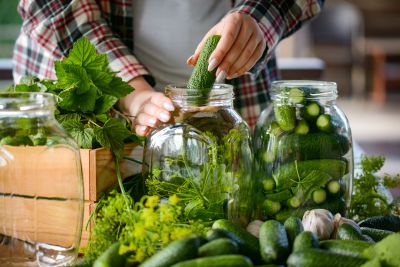
Why Are Some Pickles Crunchy and Others Soft?
There are few things more disappointing than biting into a pickle expecting a satisfying CRUNCH, only to discover something more akin to a sea slug.
But why are some pickles ridiculously crunchy while others are so... floppy?
As it turns out, pickle crunch isn't just luck. The cucumber, pickling method and how the pickle is made and stored can all play a part. And before we begin, let's acknowledge something important: Soft doesn't necessarily mean bad.
Some pickle styles are naturally softer than others. That's why crunchiness is one of the two axes in our Pickle Universe. A sharp, crunchy cornichon and a softer fermented pickle can both be excellent pickles. They're just very different beasts. So what makes the difference?
It starts with the cucumber
You can't create magnificent crunch from a cucumber that's past its prime. Fresh, firm cucumbers provide the best starting point for crisp pickles. In other words, the journey from cucumber to pickle matters before the cucumber even meets the brine.
Different cucumber varieties, sizes and maturity will also give you different eating experiences. It's one reason two jars labelled "dill pickles" can have completely different textures.
Vinegar pickling and fermentation aren't the same thing
Not every cucumber gets pickled the same way.
A quick or fresh-pack pickle is acidified using vinegar. Some are brined first and then covered with vinegar and seasonings.
A fermented pickle takes another journey to the jar. Naturally occurring bacteria convert carbohydrates into acid, changing the flavour and characteristics of the cucumber along the way.
They're genuinely different methods, not just different flavours, so naturally result in a different end product.
Heat can be the enemy of crunch
Heat is useful in preserving pickles, but too much isn't necessarily your cucumber's best friend. Excessive temperatures during fermentation can result in softer pickles.
So, there's a balance. You want a properly prepared and preserved pickle. You also want it to still behave like a cucumber rather than baby food.
Even the cucumber end matters
Here's one for your next dinner-party conversation. The blossom end of a cucumber can contain an enzyme that contributes to excessive softening. That's why pickling recipes often tell you to slice a small amount off the blossom end before pickling.
Yes, we're now discussing which end of a cucumber you should cut off.
So, is crunchier better?
We love a pickle with serious crunch, but texture is part of the pickle style rather than simply a measure of quality. And, it's really down to personal preference and what the pickle is being eaten with.
A delicate cornichon isn't trying to be a big kosher dill. A fermented Polish pickle might be softer, but it brings a sour complexity that a crisp dill pickle doesn't.
That's why the Pickle Universe maps pickles across two characteristics:
Sweetness to sourness; and
Softness to crunchiness.
Once you start to think about pickles this way, the huge variety staring back at you from the supermarket shelf starts to make more sense. And then you start to analyse every pickle you eat...